How to Calculate AGV Drive Wheel Torque and Motor Sizing
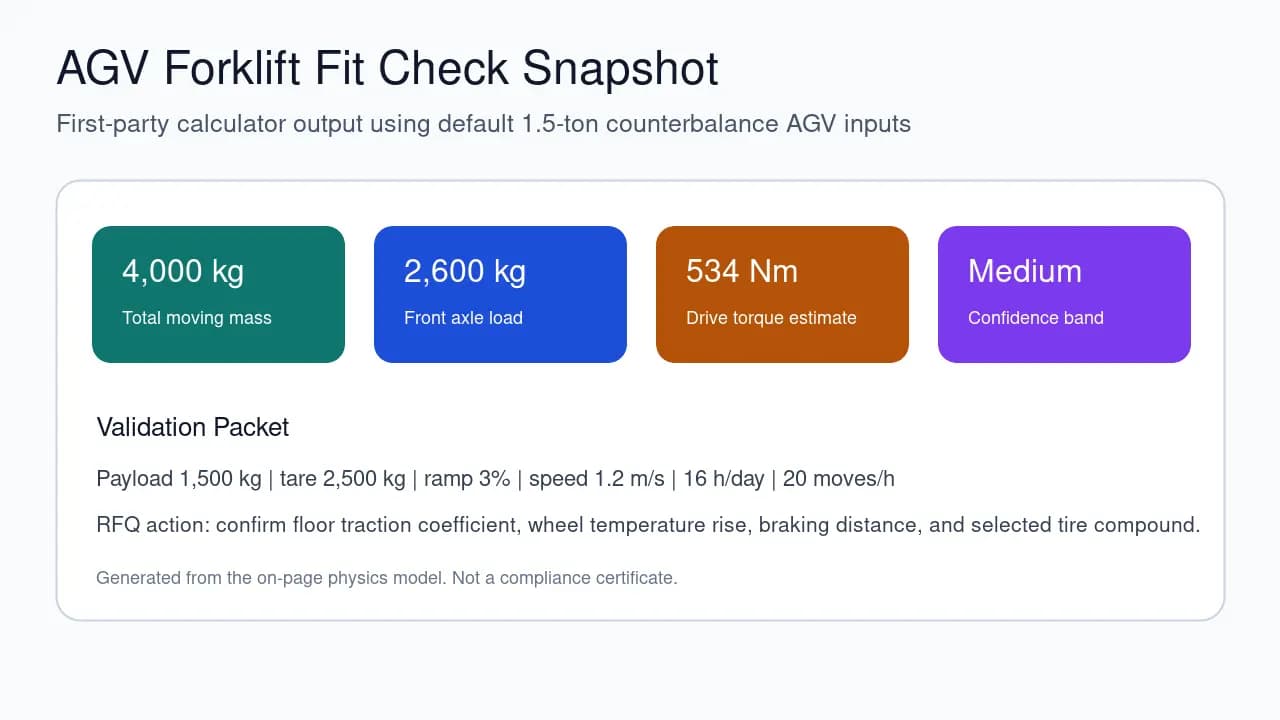
A baseline sizing method for AGV wheel torque using load, acceleration, slope, and wheel radius inputs.
Torque sizing errors are a common root cause of AGV overheating, unstable launch behavior, and underperforming pilot builds.
This guide gives a practical engineering method buyers can use before RFQ or sample review.
1) Inputs You Must Lock First
Use real operating values, not nominal brochure numbers.
m= gross vehicle mass including payload and safety margin (kg).a= target acceleration on flat floor (m/s2).theta= maximum slope angle (rad or deg).Crr= rolling resistance coefficient (floor + wheel dependent).r= loaded wheel radius, not nominal radius (m).n= number of driven wheels sharing traction.i= gearbox ratio.eta_g= gearbox efficiency.v= target travel speed (m/s).
2) Core Force Equations
Use the traction force model below for worst-case operating points.
F_acc   = m * a
F_grade = m * g * sin(theta)
F_roll  = m * g * Crr * cos(theta)
F_total = F_acc + F_grade + F_roll
Where g = 9.81 m/s2.
Then convert force to wheel torque:
T_wheel_each = (F_total * r) / nMotor-side continuous torque:
T_motor_cont = T_wheel_each / (i * eta_g)Power check at target speed:
P_wheel = F_total * v
P_motor = P_wheel / eta_system
3) Worked Example (Procurement-Friendly)
Assume:
m = 1200 kga = 0.5 m/s2- slope
= 3%(approxtheta = 1.72 deg) Crr = 0.02r = 0.10 m(loaded)n = 2drive wheelsi = 20eta_g = 0.90v = 1.5 m/s
Step 1: force components
F_acc = 1200 * 0.5 = 600 NF_grade ~= 1200 * 9.81 * sin(1.72 deg) ~= 353 NF_roll ~= 1200 * 9.81 * 0.02 * cos(1.72 deg) ~= 235 NF_total ~= 1188 N
Step 2: wheel torque per driven wheel
T_wheel_each = (1188 * 0.10) / 2 = 59.4 N*m
Step 3: add engineering margin
- continuous margin factor:
1.35(typical range1.25-1.50) T_wheel_cont_target = 59.4 * 1.35 = 80.2 N*m
Step 4: motor-side continuous torque
T_motor_cont = 80.2 / (20 * 0.90) = 4.46 N*m
This value is your minimum continuous design point before thermal validation.
4) Peak Torque and Thermal Rules
Do not size only for peak torque.
Recommended checks:
- Peak wheel torque factor:
1.8-2.2xcontinuous for short transients. - Confirm peak duration and recovery window in duty profile.
- Verify winding temperature rise at ambient upper limit.
- Validate continuous operation at target cycle, not only bench burst.
5) Typical Crr Reference (Starting Point)
| Floor condition | Typical Crr range |
|---|---|
| Smooth epoxy indoor floor | 0.01-0.02 |
| Concrete with joints | 0.02-0.04 |
| Rough outdoor transfer path | 0.04-0.08 |
Always measure or calibrate with field data before freezing final motor selection.
6) Frequent Buyer-Side Mistakes
- Using nominal wheel diameter instead of loaded radius.
- Ignoring slope torque because ramps are "short".
- Treating all drive wheels as equal traction contributors under load transfer.
- Selecting motor by peak torque only, without continuous thermal validation.
- Missing gearbox efficiency and reflected inertia impacts.
7) RFQ Fields to Request From Supplier
When asking for wheel-module recommendation, require these outputs:
- Continuous and peak wheel torque rating.
- Continuous and peak motor torque at specified ratio.
- Rated and max wheel speed under load.
- Thermal test condition and resulting temperature rise.
- Declared efficiency assumptions.
8) Buyer Decision Gate Before Sample Approval
Approve sample only if all are clear:
- Calculation basis and assumptions are documented.
- Torque reserve and thermal reserve are both quantified.
- Test condition matches your real duty profile.
- Motor, gearbox, and wheel are validated as one system.
For a manual sizing review, send payload, target speed, slope, duty profile, and wheel envelope to [email protected]. Jimmy Su will return a calculation sheet with assumptions and recommended torque range.